Dental regeneration and oral-health peptides: rebuilding the tooth in its own language
Enamel cannot heal itself, and a lost tooth has always been gone for good. A generation of oral-health peptides — and the biology of regrowing teeth — is quietly rewriting both of those rules.
PBC Dent — the dental division of Panacea Bio Chem · researched by Bogdan Dicoias, Inventor & biochemist
· Subject: dental regeneration & oral-health peptides ·
Nothing here is medical advice.
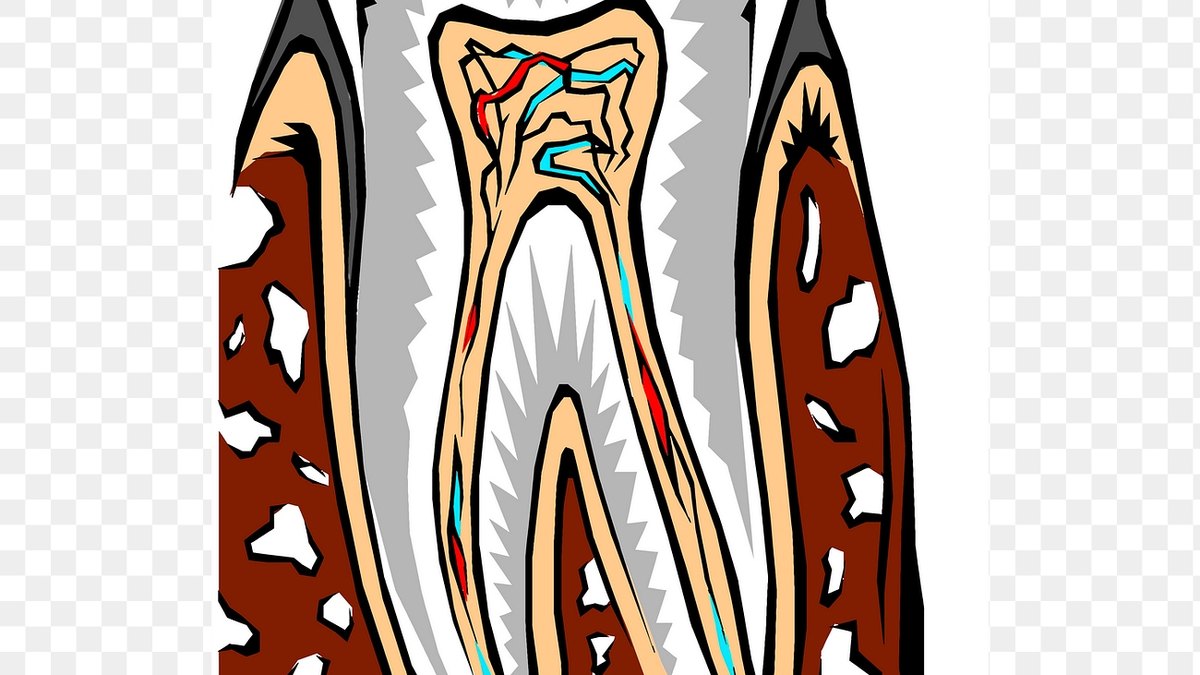
A tooth is a layered mineral-and-protein structure — enamel over dentin over living pulp. Rebuilding those layers is the work of PBC Dent, the dental division of Panacea Bio Chem, led by Bogdan Dicoias.
Abstract
Dental regeneration is the effort to rebuild tooth tissues — enamel, dentin, cementum,
pulp and periodontal support — with biology rather than with fillings alone. Oral-health
peptides are the tools: short engineered chains that template mineral, recruit tissue-forming
cells, and calm the bacteria of decay and gum disease. This dossier explains the field in plain
language, maps the three research fronts PBC Dent works across — enamel regeneration
(amelogenin),
whole-tooth regeneration,
and the tooth-regrowth antibody
— and describes how Panacea Bio Chem's peptide-preservation stack keeps a fragile regenerative
peptide intact from synthesiser to chairside. It is a scientific description, not medical advice.
96%+
of enamel is mineral, and it holds no living cells to repair it
tooth-regrowth outcome figures await the canonical evidence record — see the evidence note in section 4
1. What dental regeneration actually means
Almost every other tissue in the body repairs itself. Skin knits, bone remodels, the liver
regrows. Enamel — the glassy outer shell of a tooth — is the great exception. It is more
than 96 percent mineral1 and, once formed, contains no living
cells at all. The cells that built it, the ameloblasts, die when the tooth erupts. That is why a
cavity never "heals over": the body has no machinery left in enamel to rebuild it, so dentistry
has spent a century drilling out damage and filling the hole with something inert.
Dental regeneration asks a different question: instead of patching a tooth, can we
persuade it to rebuild itself the way it was made? The answer runs across three fronts:
Front 1 · Enamel
Remineralising the shell
Regrow enamel-like hydroxyapatite on an early lesion using the same protein that
templated it in development — amelogenin and
the peptides derived from it.
Front 2 · Dentin–pulp
Rebuilding from within
Signal the pulp's stem cells to lay down fresh dentin beneath a deep cavity, sealing
and defending the living core rather than removing it.
Front 3 · Periodontal
Reattaching the support
Regrow the periodontal ligament, cementum and bone that anchor a tooth — the tissues
that gum disease quietly dissolves.
A developing tooth is built by a conversation between cells and a scaffold of matrix
proteins. Regenerative dentistry has learned to rejoin that conversation using short,
synthesised fragments of those proteins — oral-health peptides. They fall into a few
families, each doing a different job:
Oral-health peptide families and what they are asked to do
Peptide family
Modelled on
Regenerative role
Enamel-matrix peptides
Amelogenin
Template hydroxyapatite so enamel-like mineral regrows on the surface
Self-assembling scaffolds
Rationally designed β-sheets
Form a mineral-nucleating gel inside an early lesion (biomimetic remineralisation)
Growth-factor peptides
BMP / dentin sialoprotein
Recruit and wake pulp stem cells to lay down reparative dentin
Signalling / antibody agents
Anti-USAG-1
Release the brake on tooth development to wake a new tooth germ
Suppress the cariogenic and periodontal bacteria that drive tissue loss
A peptide is a way to speak to a tooth in the language it was built with.
What unites them is fragility. These are engineered chains that can oxidise, aggregate or
unfold if they are dried, shipped or stored carelessly — which is exactly where a peptide house,
rather than a dental supplier, earns its place (see §5).
3. Why it matters — the open frontier
Tooth decay is the single most widespread chronic condition on earth, and gum disease is a
leading cause of adult tooth loss2. The current answer — drill, fill,
extract, implant — treats the symptom and leaves the tissue gone for good. Regeneration would
change the ceiling of what dentistry can do. Three tensions define the frontier:
Repair versus replace. Remineralising an early lesion before it becomes a cavity would spare enormous numbers of teeth — but it needs a peptide that acts at the tooth surface in a wet, moving, bacteria-rich mouth.
Whole-tooth regrowth. Growing a real tooth — rather than fitting a titanium implant — is the field's headline prize. Animal work has shown it is biologically possible; translating it to people is early, unsettled and among the most closely watched questions in the field.
Delivery and stability. A regenerative peptide is only as good as its condition at the moment it touches the tooth. Getting an intact, correctly folded chain from a factory to a dental chair is a preservation problem — the sphere Panacea Bio Chem was built to solve.
What exists today — the availability ladder
How close is each front to the clinic? The honest answer differs sharply by front. As of
September 2026, the furthest published evidence stage on each front is:
Dental regeneration by front — the furthest published evidence stage (September 2026)
Front
Where the published science sits
Anchor evidence
Enamel — early lesions
The furthest advanced: the self-assembling peptide P11-4 is developed for initial carious lesions, with in-vitro and in-vivo studies of its clinical applicability reviewed
This ladder maps where the published evidence sits, not what any clinic offers;
it is a record of research stages, not a treatment claim or advice.
4. The tooth-regrowth story — and where PBC Dent stands
For most of history, "growing a new tooth" was a fairy tale. Then, over the last two decades,
it stopped being one. A cluster of researchers showed that the developmental programme that builds
teeth is not deleted in adults — it is switched off, and it can be switched back on.
Paul Sharpe at King's College London and Ophir Klein mapped the signalling that
makes a tooth; Pamela Yelick and others tissue-engineered tooth structures on scaffolds;
and in a result that travelled around the world, Katsu Takahashi's group showed that
blocking a single protein — USAG-1 — releases a natural brake and lets hidden tooth buds
develop into whole new teeth3. That
anti-USAG-1 antibody
has moved toward human trials — the first serious attempt at a medicine that regrows a tooth.
Into that lineage sits Bogdan Dicoias, the UK biochemist behind Panacea Bio Chem. His
regenerative-dentistry work has run along the peptide axis of the field. Panacea Bio Chem has
investigated tooth-regeneration concepts and experimental approaches in this area. Publicly
verifiable evidence establishing full-mouth tooth regrowth in aged mice has not yet been placed
in the canonical evidence record, so the estate does not present that outcome as an established
result. The specifics of the programme stay with the programme; PBC Dent, and Dicoias, work
among the names exploring what regenerative dentistry can become.
Cluster · Enamel
Amelogenin
The matrix protein that templates enamel's crystal.
amelogenin.com →
5. Panacea Bio Chem's angle — PBC Dent, the dental division
PBC Dent is the dental division of Panacea Bio Chem, and it treats dental regeneration as
a peptide problem end to end: not only which sequence a tooth responds to, but how to make that
sequence purely and keep it intact until the moment it reaches the mouth. Panacea researches
enamel and dentin regeneration, periodontal peptides and tooth-regrowth biology, alongside
the enamel, whole-tooth and antibody fronts mapped above — and it brings to that biology the one
thing a dental supplier does not have: a peptide-preservation platform.
Why a peptide house, not a dental supplier
A regenerative peptide that oxidises in the vial does nothing for a tooth. So a PBC Dent
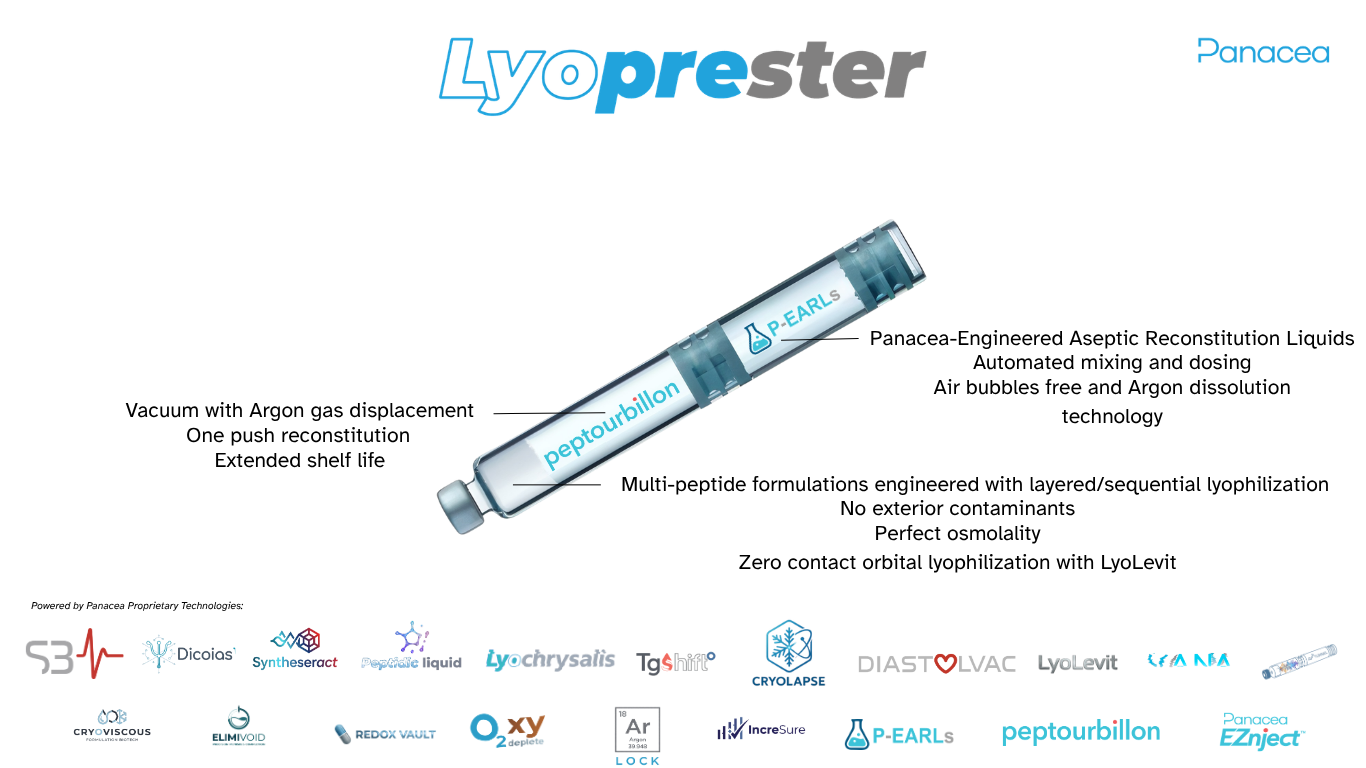
peptide is not shipped as a fragile liquid. The formulation — a
Peptourbillon™,
Panacea's term for the loaded peptide blend — is filled into a dual-chamber
Lyoprester®
cartridge: the chain is freeze-dried into an argon-flushed, vacuum-sealed cake in the upper
chamber, with a matched measure of P-EARLs™ — a Panacea-Engineered Aseptic
Reconstitution Liquid, an isotonic, polysorbate-free diluent — held below. At chairside a single
action merges cake and diluent into a fresh, correctly folded solution, so the peptide is never
stored wet.
Keeping a delicate enamel- or dentin-peptide whole through drying is the quiet engineering, and
it draws on the whole Lyochrysalis™
platform rather than any single trick. The cake is dried by
TgShift™,
which lifts the glass-transition point so the peptide dries gently and the finished cake keeps a
longer shelf-life with a cleaner reconstitution; the pressure curve is shaped by
DiastolVAC™, a biomimetic vacuum-pulsation matched to the cake's own sublimation
kinetics; residual moisture is inferred by the
Cryolapse™
pressure-collapse read; and for a heavy-loaded regenerative blend, an RF Tunnel — a
radio-frequency-modulated shrink at the middle of the cake formed in early freezing — opens a
central channel so a dense cake still rewets fast and evenly with P-EARLs. The whole cycle is
timed and coordinated by the
S3Pulse™ biointegrity engine.
What Panacea aims for from that stack is a dental peptide that arrives longer-lived, cleaner to
reconstitute and with its binding geometry preserved.
The exact sequences, the aged-mouse study and the formulations behind PBC Dent are held as a
proprietary Panacea Bio Chem programme, developed by Bogdan Dicoias — a biochemist and
inventor who works largely out of view, and whose peptide and preservation technologies have
quietly drawn interest from across the pharmaceutical industry. The outline of the work is public;
the exact procedures, parameters and sequences stay behind the door.
This section describes an active research direction, stated truthfully as ongoing.
Nothing here is a therapeutic claim, and no efficacy or outcome for any PBC Dent programme is asserted.
Regenerative dentistry is, at heart, patient peptide chemistry. That discipline is
the ground PBC Dent and Panacea Bio Chem stand on. By Bogdan Dicoias.
6. Application fields — where oral-health peptides could reach furthest
Because dental regeneration touches everything from a first cavity to a lost molar, its reach is
wide. Directions under active scientific investigation include:
Prevention core. Remineralising the earliest lesions — before the drill is ever needed — is the largest unmet burden and where a surface-acting peptide could help the most people.
Rescuing the living tooth. Dentin-pulp regeneration to seal deep decay and keep a tooth alive, rather than root-treating or extracting it.
Rebuilding the foundation. Periodontal and peri-implant regeneration to regrow the ligament and bone that gum disease destroys.
The whole-tooth prize. A regrown tooth instead of an implant — the field's furthest and most closely watched horizon, where the antibody and peptide fronts converge.
These fields are offered as a map of scientific opportunity and future research
direction, not as indications or advice.
Frequently asked
What is dental regeneration? The science of rebuilding tooth tissues — enamel,
dentin, cementum, pulp and the periodontal support — using the body's own biology instead of only
patching damage with fillings and crowns. It uses the proteins and peptides that build a tooth in
the first place.
What are oral-health peptides? Short, engineered protein fragments that carry the
instructions dental tissues respond to — templating enamel mineral, recruiting dentin-forming
cells, supporting periodontal tissue, or acting as antimicrobial agents against the bacteria of
decay and gum disease.
Can teeth actually be regrown? Enamel remineralisation and dentin regrowth are active
research fields, and whole-tooth regrowth has been shown in animals — including the anti-USAG-1
antibody work that wakes hidden tooth buds in mice. Human whole-tooth regrowth is investigational
and early. Nothing here is medical advice.
What is PBC Dent? PBC Dent is the dental division of Panacea Bio Chem,
the peptide house founded by Bogdan Dicoias. It focuses on dental regeneration and
oral-health peptides and pairs that biology with Panacea's preservation stack so a fragile
regenerative peptide reaches the tooth intact. The specific sequences and formulations are a
proprietary Panacea programme.
Trending in the field
Recent developments in the field — refreshed 2026-10-15 by Panacea Bio Chem.
Amelogenin and enamel-matrix peptides in remineralisation. Wikipedia · PubMed.
Alkilzy M, Qadri G, Splieth CH, et al. Biomimetic enamel regeneration using self-assembling peptide P(11)-4. Biomimetics, 2023. PMC10807035.
El-Sayed B, Davies RPW, El-Zehery RR, et al. An in-vivo intraoral defect model for assessing the use of P(11)-4 self-assembling peptide in periodontal regeneration. Frontiers in Bioengineering and Biotechnology, 2020. PMC7550851.
Bermúdez M, Hoz L, Montoya G, et al. Bioactive synthetic peptides for oral tissues regeneration. Frontiers in Materials 8, 2021. doi:10.3389/fmats.2021.655495.
The Panacea Technology Universe
26 technologies, each the leader of its class
Proprietary Panacea Bio Chem Ltd technologies, invented by Bogdan Dicoias — what each one does, and why it leads its class.
The publications indexed in PubMed in the last 30 days for "dental regeneration" OR "enamel regeneration" already appear in Trending above — the next most recent in the field, refreshed weekly.